Showing posts with label Tadian stories. Show all posts

Sunday, October 8, 2017

How Tadian Came to be

Please give due credit to the author. Do not copy-paste.
by: Felisa Daskeo

The first settlers of Tadian, Mt. Province came from a place called Dallikan, a place in Cervantes, Ilocos Sur, a province in the northern part of the Philippines. 

The story goes that Pagawad, Dallikan’s powerful leader, became abusive as a leader which led to his death.  The incident happened when a tribal war ensued and his own people abandoned him to be killed by their tribal enemies.

Pagawad’s death led most of the settlers to abandon the place, leaving behind only a few families.  The story goes on with a legendary story of people who followed the roots of a tree called “Batikang”, believed to have uprooted itself from Dallikan to protest the inhuman leadership of Pagawad.  People scattered in many places and settled in different places where they built villages of their own.  These places were soon named as;  Aganayang, Layogan. Alliboo and Baliw-ang.  The people soon moved and settled in different places now named as Sumadel, Lubon, Kayan and others.

Those with more food provisions were able to go further; this included the family of Kaldoongan ; believed to be the first family to settle in Tadian.

The story goes that Kaldoongan and a neighbor set out one day to fetch a pig in Baliw-ang.  This could only be accomplished in those early days by trekking mountains for days.   After two days of trekking slowly with the pig in tow, aggravated by the pig's condition being pregnant and about to give birth;  they decided to stop in Paliwak where they tied the pig to rest while they headed home to Tabiyo to get some food provisions. 

The next day when they returned to the place, the pig was nowhere to be seen but it left some traces that gave them a lead to follow.  They soon arrived in a spot where they found some freshly cut grasses scattered around with footprints that concluded that the pig has rested there for a night; although they spotted no pig around and they had to go on with the search.  The place was soon named “Igan” from the Igorot word “nao-igan” meaning cut grasses scattered around.

Kaldoongan and his company continued the search for the pig and soon reached a place where they found some freshly cut grasses gathered and piled together that indicated the presence of the pig in that spot.  The place was soon named “Logpop”. From the Igorot word “natotopopan”, meaning grasses gathered together.  The men were dismayed because the pig was nowhere to be seen. 

It was getting late in the afternoon and without food provision; the men decided to stop the search and go home then return the next day with additional men to continue the search.  In those early days, animals were very important to the native settlers, so it was not a surprise if they kept going back in search of just one pig.  What worried them more was that the pig could have given birth by now.

The men returned the next day in search of the lost pig and found a spot where they believed the pig settled in for the night because of a mound of freshly cut grasses and some footprints around it.  Because of the mound of grasses which they termed, “Napapatog-o”, meaning a mound, the place was soon named Patog-o.

The search was getting better.  The men knew that the pig was somewhere around and not too far from them.  They however found no pig nearby so the search went on as they followed the lead provided by the pig.

At last, they arrived at a place where water was gushing.  From the base of a big tree, water was freely flowing.  This could be the only possible place where the pig could stop if it was trying to find something for survival. The pig is wise because it looked for the right place to go and give birth.
Water from the roots of the Balite tree is still gushing up to now in DANUM.

The base of the Balite tree where the water is coming out.


The men found the pig huddled with its piglets.  It was the perfect place to build a village in that there was good supply of water.  The family of Kaldoongan soon settled in the same spot where the lost pig led them. And so goes the story of Tadian.

The place was named “Danum” meaning water.  Up to now, even during summer, Danum has water where people fetch water when water is scarce.

What is interesting is that, the settlers of Tadian, Mt. Province started with the search of a lost pig.  It was the pig that led the family of Kaldoongan to the perfect place to build a home and settle down.

How Tadian Came to be

Please give due credit to the author. Do not copy-paste.
by: Felisa Daskeo

The first settlers of Tadian, Mt. Province came from a place called Dallikan, a place in Cervantes, Ilocos Sur, a province in the northern part of the Philippines. 

The story goes that Pagawad, Dallikan’s powerful leader, became abusive as a leader which led to his death.  The incident happened when a tribal war ensued and his own people abandoned him to be killed by their tribal enemies.

Pagawad’s death led most of the settlers to abandon the place, leaving behind only a few families.  The story goes on with a legendary story of people who followed the roots of a tree called “Batikang”, believed to have uprooted itself from Dallikan to protest the inhuman leadership of Pagawad.  People scattered in many places and settled in different places where they built villages of their own.  These places were soon named as;  Aganayang, Layogan. Alliboo and Baliw-ang.  The people soon moved and settled in different places now named as Sumadel, Lubon, Kayan and others.

Those with more food provisions were able to go further; this included the family of Kaldoongan ; believed to be the first family to settle in Tadian.

The story goes that Kaldoongan and a neighbor set out one day to fetch a pig in Baliw-ang.  This could only be accomplished in those early days by trekking mountains for days.   After two days of trekking slowly with the pig in tow, aggravated by the pig's condition being pregnant and about to give birth;  they decided to stop in Paliwak where they tied the pig to rest while they headed home to Tabiyo to get some food provisions. 

The next day when they returned to the place, the pig was nowhere to be seen but it left some traces that gave them a lead to follow.  They soon arrived in a spot where they found some freshly cut grasses scattered around with footprints that concluded that the pig has rested there for a night; although they spotted no pig around and they had to go on with the search.  The place was soon named “Igan” from the Igorot word “nao-igan” meaning cut grasses scattered around.

Kaldoongan and his company continued the search for the pig and soon reached a place where they found some freshly cut grasses gathered and piled together that indicated the presence of the pig in that spot.  The place was soon named “Logpop”. From the Igorot word “natotopopan”, meaning grasses gathered together.  The men were dismayed because the pig was nowhere to be seen. 

It was getting late in the afternoon and without food provision; the men decided to stop the search and go home then return the next day with additional men to continue the search.  In those early days, animals were very important to the native settlers, so it was not a surprise if they kept going back in search of just one pig.  What worried them more was that the pig could have given birth by now.

The men returned the next day in search of the lost pig and found a spot where they believed the pig settled in for the night because of a mound of freshly cut grasses and some footprints around it.  Because of the mound of grasses which they termed, “Napapatog-o”, meaning a mound, the place was soon named Patog-o.

The search was getting better.  The men knew that the pig was somewhere around and not too far from them.  They however found no pig nearby so the search went on as they followed the lead provided by the pig.

At last, they arrived at a place where water was gushing.  From the base of a big tree, water was freely flowing.  This could be the only possible place where the pig could stop if it was trying to find something for survival. The pig is wise because it looked for the right place to go and give birth.
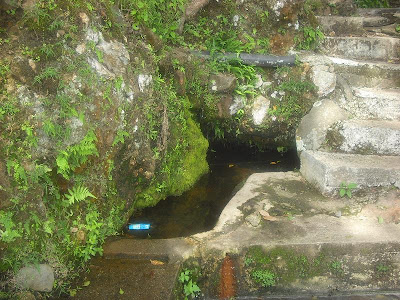
Water from the roots of the Balite tree is still gushing up to now in DANUM.

The base of the Balite tree where the water is coming out.


The men found the pig huddled with its piglets.  It was the perfect place to build a village in that there was good supply of water.  The family of Kaldoongan soon settled in the same spot where the lost pig led them. And so goes the story of Tadian.

The place was named “Danum” meaning water.  Up to now, even during summer, Danum has water where people fetch water when water is scarce.

What is interesting is that, the settlers of Tadian, Mt. Province started with the search of a lost pig.  It was the pig that led the family of Kaldoongan to the perfect place to build a home and settle down.

Friday, October 6, 2017

The Igorots and the Untold Stories

Please give due credit to the author. Do not copy-paste.
By: Felisa Daskeo

Most Filipinos probably do not know that a huge number of Igorots are scattered around the world. There’s a top notch lawyer out there, an engineer, an accountant, a business man, a doctor, a police general, but they don’t carry with them tags or banners to identify themselves as Igorots.

That said, I will now begin to bring you around my humble hometown nestled between tall mountains; where lawyers, engineers, accountants, high ranking policemen, doctors, teachers, nurses, midwives, abound nowadays.

Tadian, Mt. Province is a home to more or less 5000 residents. Of course, they are Igorots, except for a very few that you could count with your fingers who are from other regions in the Philippines, mostly because they have married an Igorot. 


In the year 1960s, I could still vividly remember how our elderly would exclaim happily every time an airplane was heard overhead, “Oh, that’s ___________ flying by.” I can’t remember the name of the pilot. I was still a very young girl then.  Oh, thanks goodness, someone, a kind kailyan (town mate), shared the name of our first pilot in Tadian. He was the late Victor C. Astudillo.

Now that it is 2017 and I still hear and read expletives hurled against the Igorots, aggravated with descriptions like pigs, pangit, dogyut(untidy), and ignoramus, my thoughts travel back in the 1960s when we already have a pilot in our hometown.

Let's take a break first so I can share this FB post I recently read in Facebook. 


Yeah, that maybe taken just as a joke but there is truth in those questions. Perhaps you don’t believe it but the man you see resembling a beggar maybe the owner of a multi-million-peso vegetable garden, who supplies the vegetables you eat; who drives a Montero around, who lives in a mansion but who wears no ties, no well-pressed slacks and polo shirt except for worn-out jeans, cowboy boots and a leather jacket.

If you have still time to read, click and read this anecdote of an Igorot man and see what I mean.

Back to where I started, some people think that Igorots are still way behind modern civilization. To tell you the truth, several Igorots are serving many Filipino people. There are judges out there, police superintendents, lawyers, accountants, doctors, midwives, engineers and many more who are working their butts off for the people.

In Tadian, Mt. Province, my hometown, every parent is striving hard to send the children to school. Education is necessary and getting a diploma in college is every child’s dream. 

The house below that is as big as 4 townhouses combined is where a CPA-Lawyer resides. Not content to be an accountant and a business owner, she juggled her time between her job, taking care of her thriving business and going to her law class during weekends. She successfully passed the recent bar exams and she’s now a certified lawyer and an accountant. Her accomplishment does not rest in her personal achievements alone because her 3 children are themselves achievers in their schools. They are the top students in their classrooms.


Walk a little further and you can find a humble dwelling that produced 7 smart children who are also achievers in their own field of education. The family has two judges, a nurse, a teacher, a police superintendent, a forester, and a businessman. They have gone a long way in their professions and are all on top of their careers. Two years ago, one of the members of the family was one of the top five among the graduates of PNPA (Philippine National Police Academy). There are more achievers in the family as the family grows.
These are only a few of the achievers in my hometown. This post could become a book if I mention everybody here and tell his or her story one by one. In the neighboring towns, there are countless achievers too. They are either working in the country or else deployed in other countries. 

Igorots are hard-working people and dedicated to their jobs. That’s one thing that an Igorot man or woman possesses and there is no doubt about that. What makes them shine even more is that they are frugal and know the importance of money.

It is worth noting that Igorots come in many colors and shapes just like other Filipinos. You can see them anywhere, from the farm to the corporate world, politics, showbiz, furthermore, they can be anywhere, from the freezing cold Canada to the blazing hot desert in the Middle East and they are all working hard just like many other Filipinos.


The Igorots and the Untold Stories

Please give due credit to the author. Do not copy-paste.
By: Felisa Daskeo

Most Filipinos probably do not know that a huge number of Igorots are scattered around the world. There’s a top notch lawyer out there, an engineer, an accountant, a business man, a doctor, a police general, but they don’t carry with them tags or banners to identify themselves as Igorots.

That said, I will now begin to bring you around my humble hometown nestled between tall mountains; where lawyers, engineers, accountants, high ranking policemen, doctors, teachers, nurses, midwives, abound nowadays.

Tadian, Mt. Province is a home to more or less 5000 residents. Of course, they are Igorots, except for a very few that you could count with your fingers who are from other regions in the Philippines, mostly because they have married an Igorot. 


In the year 1960s, I could still vividly remember how our elderly would exclaim happily every time an airplane was heard overhead, “Oh, that’s Victor flying by.” Because at that time, there was already a pilot from Tadian, Mt. Province. I can’t remember the name of the pilot. I was still a very young girl then.  Oh, thanks goodness, someone, a kind kailyan (town mate), shared the name of our first pilot in Tadian. He was the late Victor C. Astudillo.

Now that it is 2022 and I still hear and read expletives hurled against the Igorots, aggravated with descriptions like pigs, pangit, dogyut(untidy), and ignoramus, my thoughts travel back in the 1960s when we already have a pilot in our hometown.

Let's take a break first so I can share this FB post I recently read in Facebook. 


Yeah, that maybe taken just as a joke but there is truth in those questions. Perhaps you don’t believe it but the man you see resembling a beggar maybe the owner of a multi-million-peso vegetable garden somewhere in the Cordillera Region; who supplies the vegetables you eat; who drives a Montero around, who lives in a mansion but who wears no ties, no well-pressed slacks and polo shirt except for worn-out jeans, cowboy boots and a leather jacket.

If you have still time to read, click and read this anecdote of an Igorot man and see what I mean.

Back to where I started, some people think that Igorots are still way behind modern civilization. To tell you the truth, several Igorots are serving many Filipino people. There are judges out there, police superintendents-even generals, lawyers, accountants, doctors, midwives, engineers and many more who are working their butts off for the Filipino people.

In Tadian, Mt. Province, my hometown, every parent is striving hard to send the children to school. Education is necessary and getting a diploma in college is every child’s dream. 

The house below that is as big as 4 townhouses combined is where a CPA-Lawyer resides. Not content to be an accountant and a business owner, she juggled her time between her job, taking care of her thriving business and going to her law class during weekends. She successfully passed the bar exams and she’s now a certified lawyer and an accountant. Her accomplishment does not rest in her personal achievements alone because her 3 children are themselves achievers in their schools. They are the top students in their classrooms.


Walk a little further and you can find a humble dwelling that produced 7 smart children who are also achievers in their own field of education. The family has two judges, a nurse, a teacher, a police superintendent, a forester, and a businessman. They have gone a long way in their professions and are all on top of their careers. A few years ago, one of the members of the family was one of the top five among the graduates of PNPA (Philippine National Police Academy). There are more achievers in the family as the family grows. The recent bar exam has added another 2 lawyers in the family.

These are only a few of the achievers in my hometown. This post could become a book if I mention everybody here and tell his or her story one by one. In the neighboring towns, there are countless achievers too. They are either working in the country or else deployed in other countries. And these are all Igorots who are often discriminated in their own country.

Igorots are hard-working people and dedicated to their jobs. That’s one thing that an Igorot man or woman possesses and there is no doubt about that. What makes them shine even more is that they are frugal and know the importance of money.

Igorots are one of the people you could trust. Just look at the taxi drivers in Baguio City who are considered the most trusted taxi drivers in the Philippines. If you hire a taxi in Baguio City, there's no need to worry how much you are going to pay because they charge fairly according to the regular rate and they don't ask for more. If you leave some valuables inside the taxi, you can rest assured that your money, cellphone or other valuables will be given back to you

It is worth noting that Igorots come in many colors and shapes just like other Filipinos. You can see them anywhere, from the farm to the corporate world, politics, showbiz, furthermore, they can be anywhere, from the freezing cold Canada to the blazing hot desert in the Middle East and they are all working hard just like many other Filipinos.


Tuesday, October 18, 2016

"Apade" - The Igorot Fairies


by: Felisa Daskeo

My father was a prolific storyteller who spiced my youth with interesting if not adorable stories. There was this strange story that was left unexplained.I haven't heard any development of this story since then, but I believe it was true.


When tribal wars were still predominant in our region; an unexplained phenomenon kept my father’s village safe from the neighboring enemies.

As soon as darkness swallowed the village, clusters of lights out of nowhere surrounded it and kept the enemies at bay. They called these "APADE". And they are like moving torches. These were the fairies of the Igorots in Tadian Mt. Province.

My father said that Tadian, Mt. Province has never been attacked by the enemies since they thought that the lights were the villagers themselves protecting their village.

When we were young, we often saw lights scattered around the mountains. We often thought they were men, but we learned from my father that they were not. They were the "APADE", which were like fairies of the town.

There was this story a long time ago about a man who caught one of them out of curiosity and was surprised to discover only dirt on his hand.

When modernization was adapted by the Igorots, the "Apade" slowly left the village. There was this story told that a man once saw lights parading away from the town and a voice saying, "We'll leave this place. We are of no use anymore." Perhaps they left to find another place to protect from danger. As for Tadian, it still is a very safe and peaceful place to stay even to these days. 


Sad to say, these considered fairies slowly vanished with the modernization of lifestyle. They say that these fairies were driven away by modern technology. They love peace a long time ago.

Copyright 2020 Felisa Daskeo. Do not copy.


What's even sadder is that these fairies will never come back to Tadian.


Sunday, August 26, 2012

The Footprints of Kabunian Embeded on a Rock in Tadian, Mt. Province


by: Felisa Daskeo

Tadian, Mt. Province is one of the very quiet towns in the northern part of the Philippines, this is the place where Kabunian- the Igorot God was believed to have stepped down because he left footprints on a big rock.  Just like the many other towns in the Philippines, Tadian has also its share of folktales, beliefs and practices.  Because the olden times were primitive times, people didn’t write stories.  They were merely related from mouth to mouth.  Most of the stories were told by the old men and women and nobody dared wrote them and made books about them.

Look closely at the center part and you can see the a pair of footprints.  The left footprints have the holes on the toe part.
The Footprints of Kabunian (The Igorot God), has been told and retold several times by the old folks of Tadian Mt., Province.  

The story goes that, in the very olden days some old men who were gathered in a place called Bimmukod witnessed a very strange sight.  The old men gathering in a certain place is a normal situation in Tadian as the old men often gathered together in a certain place in order to settle disputes or talk about some very important matters because in those olden times, the old men were the law and they were the wise men who talked about problems in the community and offered solution or else settled them.
If you look closely, the footprints are there but they are obscured by the dirt.


It was told that suddenly, the men were disturbed by the sudden appearance of a man from out of the blue.  He was a very strange man; described by the old men as foreign looking, tall, huge with a very fair complexion.  The man just came out from a place they called “Liang”.  Liang means a very shallow cave.  There is a big rock here and below it is a very shallow cave. 
Look at the little holes.  Those are the toes.

No one saw where the stranger came from, but they spotted him first in Liang.  The men merely watched in awe and shock as they were blinded by the glittering hair of the man and his shining clothes.  With a walking cane and a dog, the men recognized him as Kabunian.  The stranger walked to the rice paddies with fast strides, then disappeared in the woods and was never seen again.

Shocked but still conscious, the men went to see the big rock where the man was first spotted and to their amazement; they saw fresh footprints embedded on the rock.  The man left footprints on the hard rock, which was impossible for an ordinary man to do.  This time the men have proven that the man was no ordinary man and that he was Kabunian because what normal man could leave footprints on a rock?  Only Kabunian, their God, is capable of leaving an indelible sign.  There were big footprints embedded on the rock with the traces of the dog's footprints too and the cane being stuck on the rock.  All these were tangible signs of Kabunian's visit to the place.

And so the story of the old men who witnessed the passing of Kabunian and his dog in Tadian was handed down from generation to generation until I heard it and I thought it was worth writing for the people to learn that there are some events that are like fairy tales but there is proof that the story of the strange man has really happened a long time ago.

The footprints on the rock are still there, ; embedded and had stood the harsh times but marred by the passing of time.  When we were small kids, we always went to play on the big rock and I can still remember clearly that the footprints then were still clearly embedded on the rock.  The last time I visited the place in May 2012, the footprints were not any more prominent.  They were obscured by accumulated dirt and weathering, but the big footprints are still there and you can notice them when you look closely.  The sizes of the footprints are too big for a normal Igorot man.  The footprints are too large.

Kabunian who was believed to have stepped down in Tadian, Mt. Province may have been watching the place for a long time until he finally left the place for good.  Where?- nobody knows but the people believe that Tadian, Mt. Province is a blessed place visited by Kabunian.  

The strange man was never spotted again and the people concluded that it was really Kabunian who passed by the place.

Basing from the many stories that circulated for perhaps hundreds and hundreds of years, Kabunian always held a cane and was always accompanied by his dog.  

Copyright 2012 Felisa Daskeo

Tuesday, December 28, 2010

A Beautiful Mountain Peak believed to be Once a Volcano

I grew up believing that the mountain below my hometown was once a volcano.

We call it Mugao in our dialect which in English means a "PEAK".

It is an extinct volcano according to our old folks and in fact even our old folks who have reached hundred years and have already passed away a long time ago haven’t seen the mountain peak alive to prove that it really was a volcano once.

 Perhaps it was once a volcano that became extinct hundreds or many thousands of years ago.


The mountain stands proudly overlooking the many villages surrounding it.  In fact it is here near this mountain peak where a small pond with 3 eels believed to have existed hundreds of years. 
When we were kids, we loved to go to the place and watch the eels swim and hide from us.  They seem to know when people were around them.  People around the place took care of the eels very well and forbade kids from hurting them and fishing them for food because they believed that the eels were spirits that cast spells to people who hurt them.  These eels are enchanted according to the villagers.

The people around the place almost adore the eels.

The mountain peak is not so high but it is a lovely peak which is a good climbing spot for mountain climbers.  The mountain is a rocky one so it is impossible for big trees to grow and only shrubs and grasses could be seen on it.

Wednesday, April 28, 2010

Apo Keeg, The Man of Tadian Mountain Province


He was the oldest man I have seen who could appreciate pictures without glasses on, that was more than twenty years ago and Apo Keeg  was already more than a century old that time in 1994 when I last saw him.  He passed away after a few years after the interview I had with him. Unluckily I wasn’t present and I missed a lot of opportunities to have taken his picture as he was paraded around town to give him the respect that he deserved.  

Yes, Apo Keeg is considered a hero in my town and he was a real hero to his people.  

 I sat beside him on the long wooden chair, watching his century-old smile that I haven’t seen for a few years.  Back then I was on emergency leave from my job in Hong Kong because my father passed away.  Although my vacation wasn’t for fun I was still delighted for the chance of interviewing the man I had idolized for many, many years since I was still a young high school girl.  I was hoping to write an article about him in one of the magazines owned by a Filipino in Hong Kong.  He has been always a favorite of mine even when I was young and was hoping to someday become a writer and write something about him.  But the interview was impossible because Apo Keeg has returned to his childhood days.


Apo Keeg’s life story was related to me by my elder brother, Manong Pacio.  Some were murky memories that I heard from my father a long time ago when he was still living with us.  I had clarified it with my brother and made sure the stories were correct.  This is not a complete story but the most important events and achievements of Apo Keeg are here.  I hope to write some more about Apo Keeg in the future.

Apo Keeg - ( Apo is an address used as a respect to older men and women.  It could also mean a high regard or respect for a person of authority.) – as he was addressed by all of us was a man who was old and wrinkled but the years he had spent on earth was considered very fulfilling not only for him but most especially for his people.  A man like him is rare and I would have loved him to have lived a thousand and one years.
The author with Apo Keeg in October,1994.
Apo Keeg’s life came as an issue of curiosity and a source of inspiration in my dreams of becoming a writer while I was a young girl playing on the streets with other kids my age.  I never even had that simple notion that Apo Keeg who looks so cute and fragile was that strong a man to have done such enormous achievements both in strength as well as brains.   I am perhaps the luckiest woman to have been the only one who has given him something special even if he has been gone from us for a long time.  This is such an honor for me to do for him and to the people of Tadian, Mt. province.  In the hope that the great works of Apo Keeg will be preserved. I made my research and wrote something about his achievements in life.

The years that Apo Keeg had spent on earth is considered a record for he was able to live a long life of 115 years and beyond that are the treasures that he has handed down to his people.  Many years ago, he was one of the most honored men in Tadian.

Tadian wouldn’t have become a town if not for Apo Keeg.  Apo Keeg worked hard for the transfer of the municipality from Kayan to Tadian.
In 1942 amidst the World War II that ruined countless properties and killed countless number of people, Apo Keeg joined the forces to fight for his people.  Despite the dangers of joining the forces, Apo Keeg ignored it and fought instead.  There were always dangers of course but perhaps Apo Keeg was one of those spared from the devastating war because he had a mission to fulfill for his people.  His courage and loyalty to the people won the hearts of everybody and he was appointed municipal councilor, despite illiteracy.

When Apo Keeg was appointed councilor, his grade 2 son has to teach him to scribble his name.  But illiteracy wasn’t a hindrance in Apo Keeg’s dream to serve his people.  He did everything to make the people realize that he was worthy to be a leader.  He served the people with no bad records and bad issues about his service from 1942 – 1944. The issues over illiteracy didn’t stop Apo Keeg from running for mayor in 1945.   There was loud clamor from his supporters for him to run for mayor because they have proven his worth when he was still a councilor.  The support he had from the people was so great that his opponents feared his victory over them.  To get rid of his votes, his opponents snatched the ballot boxes to make sure that Apo Keeg will lose.

In those olden days when life was still very primitive in the mountains, when paper and pens were not in stores and very few people went to school, the Igorots used colored papers to cast their votes.  Apo Keeg chose green as his color.  During the election, the ballot box of Apo Keeg was stolen. Perhaps his opponents thought Apo Keeg will lose his votes from his supporters but the people were wiser than the educated opponents.  While Apo Keeg’s opponents were busy trying to cheat for their victory, the people were smarter than them.  Who could have thought of banana leaves as substitute for the green colored paper?  Casting their votes using banana leaves, Apo Keeg won by a large margin over his rivals.
                        
As a public servant, Apo Keeg has been loved by the people.  

Here are the titles that the people have given Apo Keeg:

Father of the People and Father of the Igorots

As a Father of the People, Apo Keeg has been always available for the people.  People approached him for every problem they had, and Apo Keeg tried to do everything he could to ease their problems.

Head of the Igorot Traditions

As the Head of the Igorot Traditions, Apo Keeg was always there to teach the other men to perform their rituals which they believed could cure sick people, cleanse bad vibes and drive away bad spirits around.    I have always believed in the beliefs of my people up to now because I could see the relevance to real life situations and they work for me and the others.  Would you believe that the old men have a ritual for men and women who are in the critical age of not getting married too?  Yes, with just a few rituals, the man or the woman would be tying the knot with someone.  It is hard to believe but then I was there and I’ve seen everything.

Miracle Doctor

Apo Keeg was known as the Miracle Doctor.  This was his greatest contribution to his people as a public servant.  Apo Keeg was known for delivering babies in this world just like a real doctor.  According to the people whom I interviewed, they considered Apo Keeg as a better doctor for delivering babies than the midwives and the real doctors around.  This made him the most sought after by women who were laboring.  In those days when there was no easy access to medical gadgets and machines, Apo Keeg has proven that even with just the bare hands, he was able to deliver a hundred babies on earth, thus his title, Miracle Doctor.

One very remarkable incident happened in 1960 when a woman had a still birth and the baby was pronounced dead.  Being a gifted doctor, Apo Keeg didn’t lose hope upon seeing the dead baby.  He burned an old army blanket (blanket from the US army that came from relief good for the minorities and from World War II).  He put the placenta over the burned blanket to warm then slowly pushed the liquid to the baby’s stomach through the uncut cord.  After a few minutes, the baby moved.  The baby lived and grew up a healthy boy. I came to know from a kind kailian that the baby was Elmer Hull. He is a half-Igorot, half-African. His mother is from Tadian, Mt. Province and he is a country music singer until now.

Apo Keeg is a man of his time.  What he did was more than what any leader had done to his people and from there his people had reserved some traditions that up to now are being practiced.  Although a lot has changed in Tadian, the fact still remains that Tadian will live to be a place molded by the best man I’ve ever known in my younger years.

Wednesday, September 30, 2009

Tadian, Mt. Province an Emerging Town in The Philippines

by: Felisa Daskeo

Tadian, Mountain Province is just another simple, unknown town in the northern part of the Philippines. Perched between tall mountains overcrowded with tall pine trees and rocks that looked like guards above, Tadian is as quiet as the cold morning breeze and as serene as the mountain overlooking it. The tranquility of the town makes one feel so cozy and at peace with the rich nature surrounding it. Living in this town makes one feel so protected and blanketed with the calmness and peace that easily devours the innermost being.


Yes, this is my hometown that I call home. Home because even if I don't live now in the place, the mere thought of the place makes me feel at ease and safe.

Nature around is what makes the place rich. Nature was so kind. The land is fertile and although it is mountainous is fit for planting. The Igorots terraced the terrains in order for them to be able to plant rice and vegetables. This rice terraces is one of the wonders of the world that kept people imagining how all those rice terraces were so perfectly and beautifully carved in the mountains.
The rice terraces are just a few meters away from the beautiful houses.
But these were not done overnight, instead, the rice terraces were created by the Igorots since the time that man has learned to use tools. I imagine they had made use of the crude tools of primitive times. Until now, men are still building rice terraces in my hometown. That is their way of life and for as long as man is alive the rice terraces will still be built by my people.

Igorots are known as very hard-working people. This was proven by what they could do to the mountains around them. No man could build rice terraces as incredibly as the Igorots. They are natural engineers who love terracing mountains in order to make a living.

Igorots are early risers. They go to the fields at dawn until sunset. The women carry crops on their heads to bring home to their families. while the men carry them on their broad shoulders.
The woman is already in her seventies, but she still goes to the fields.
When I was a little girl, I could still remember how my father and my grandfather woke up at three in the morning to prepare their food and then go to the fields as early as four o’clock in the morning. Nobody was allowed to sleep until sunrise. According to the old men and women, a person who wakes up late will not be able to accomplish something.

The Igorots have emerged with the drastic change in technology and they cannot be left behind. This is not impossible because of their love for education. Most of the new generations are now degree holders and they are either out in the cities or else in other countries working and developing their skills.


Even the types of houses built in Tadian are affected by the modern life. You cannot see anymore the traditional houses around but big, concrete houses that are at par with the houses in other communities in the Philippines.
This house is already an antique house. In the 1960s, this was the best house I have ever seen in my life, but today there are more and more beautiful houses being constructed in Tadian.
Tadian town is now populated with beautifully constructed houses. Below are a few of them.


Some people might think that Igorots are pagans. While our ancestors had their own beliefs and their God, we are Christians and we have our church.
This is a Roman Catholic church.

The old tradition of burying the dead in the yard is not anymore a practice in Tadian. There are two cemeteries in the town which are both free.

My father who passed away in 1994 was buried in the cemetery.

A walk around town will bring you to a memorable place where I finished my elementary education. The Tadian Central School is only a few meters away from our old house and I walked to and from school every day.


Walk further and you will see a stairway that seems to lead to heaven. And there you find the Tadian Municipal Hall.


And then, going up the road, you will finally find the school where I finished my high school education. Now, Tadian School of Arts and Trades where I studied in the 1970s has now become a Mountain State Polytechnique College that caters to both high school and college students.
This is the academic subjects building. There are several other buildings around.
I have walked you around my town and hope you have enjoyed it. Thank you for dropping by.

Copyright 2009 Felisa Daskeo

Saan Daw Nakatira ang Igorot

 Are you also wondering where an Igorot lives? I know. I know. Many people still believe that an Igorot is a primitive, ignoramus human bein...