
Showing posts with label Igorots. Show all posts
Showing posts with label Igorots. Show all posts
Monday, April 13, 2020


Saturday, April 11, 2020
"Kasiyana sa", Igorot Word of Reassurance Amidst Uncertainty and Hopelessness in COVID-19
 |
| Igorots are simple people. |
Let’s have a breather to deviate and ease our COVID-19 saturated minds from this mayhem.
What do Igorots have in store for this chaotic situation we are in?
It is the reassurance that everything will be all right, and this perplexing situation will get better for all of us tomorrow. "Kasiyana sa."
I find it hard how to express myself while thinking of how many of us also feel about the havoc this pandemic has brought to this world. But let me tell you, "Kasiyana sa", this too shall pass just like what everybody is wishing and things will soon be back to normal. This is no easy feat but I'm sure with resilience and discipline inherent amongst us, we will pull through and get over this difficult situation.
To the Igorots, if there is “Inayan sa,” to forbid misconducts and wrongdoings to avoid bad karma; in times of uncertainties like what we are all experiencing today - the COVID_19, there are also reassuring words to uplift the spirit of those who despair and are losing hope.
I’m sure the Igorots are saying, “Kasiyana sa.” and "Laton sa."
Yes, me too. I want to remain adamant and be positive about what will happen because I strongly believe that all these will soon pass and tomorrow will be a better day for all of us. “Kasiyana sa.”
“Kasiyana sa,” is a Kankanaey word that gives assurance in times of uncertainty and hopelessness. It was what our ancestors have passed to the next generations. That in times like this pandemic, people should keep calm and be strong because “Kabunian”, the Igorot God, is always there to stand by them no matter what difficulties they are going through.
I remember my parents a long time ago, they always eased our bad feelings with the short sentence, “Kasiyana sa.” In difficult times; like when we were sick, when there was a problem, when we were almost losing hope, and when someone is having a hard time with something else, their word of reassurance kept our spirits up.
My father used to tell us how they had survived World War II without experiencing extreme hunger. Some thought it was already the end of the world, and those who thought of the end of the world were the same people who stopped working on the fields because they thought they were only wasting their time toiling the land if the world would end, anyway. When the war finally ended, it was those who continued working amidst the war who didn’t go hungry. Those who stopped working on the fields to plant crops for sustenance experienced extreme hunger after the war.
It's the same reason our father always advised us to keep going, no matter the situation. Because everything, no matter how difficult and hopeless it may seem, will have an end.
My father would often tell us, “Kasiyana sa.” Everything will be fine. Things will soon get better. And it provided us with the hope and comfort we needed, which gave us the strength to face the difficulties.
There’s another uplifting word of the Igorots. They say, “Laton sa,” to mean the positive result of something.
They say, “Laton sa,” to mean everything is fine and good.
During this time when COVID-19 is creating stress, depression, difficulties, and doubts in our minds, we say “Kasiyana sa.” or “Laton sa.”
Let’s think of the positive things this pandemic has done to us. It wasn’t all that negative; we learned how to be more prepared for this kind of problem.
In the end, we will have something to thank COVID-19 because we learned a lot of lessons we have missed in normal situations.
I'll end this with, "Kasiyana sa."
Copyright 2020
Tuesday, April 7, 2020
Igorots Coping Amidst COVID-19
Please give proper credit to the author.
Do not copy-paste.
by: Felisa Daskeo
I've been thinking a lot about the Igorots in this time of pandemic and crisis whilst they are in a dire situation yet they are coping amidst the COVID-19 and they are surviving the situation with or without the help of the government.
Remember Mayor Gabino Ganggangan of Sadanga, Mountain Province, who refused the food packs from the Municipal Social Welfare and Development Office for his constituents? In his statement and I quote, "Let the national Government feed those more needy urban poor in the cities and those less fortunate in other areas who can't sustain themselves, while we sustain ourselves while we can."
His statement is very true of the Igorots. It is not a boastful act but an inherent attitude of the Igorots who can sustain themselves even in the direst of situations. As Igorots, they were taught to live within their means. Igorots don't practice extravagant life, even if they have the means to do so. Luxury is not part of their simple life and to top it all they want to gain money honestly because they abide by their ancestors' words, "Inayan sa."
“Inayan sa." It's a short sentence full of sense and meaning. To the Igorots they say, "Inayan sa", to all acts against human rights and moral values. They say, "Inayan sa", to someone who violates laws. In short, it is what makes an Igorot the way he is.
Here are some Inherent Characteristics of Igorots why they can survive during Crisis.
1. Resilience - Igorots are perhaps one of the most resilient people. They have strong personalities that help them recover easily during times of crisis. They have the ability to adapt to any situation.
2. They live within their means. - Igorots don't practice extravagant life. They live a simple lifestyle like their ancestors and content themselves with what they have. They are not fond of jewelry and other luxuries that are only embellishments and unnecessary in their daily life. Just because Juan has a new television means Pedro will also buy one. It is not what they were taught. If you don't have extra money to buy "luho”, then be content with what you have.
3. They always think of others. - Igorots always think of others and are not selfish. They always think of the word, "Inayan sa." Greed of power and money is frowned upon by many Igorots.
4. They always save for a rainy day. - Igorots aren't one day millionaires. They always think of the future. Their "agamang" rice granary is always full. So the rice supply could sustain them for a year or more. Farmers plant rice in the rice terraces only once a year. So, they make sure they have enough rice supply before harvest season comes again. Igorots are heavy rice eaters because they work very hard to sustain themselves. They aren't used to charities from other people unless needed. In times of crisis such as this COVID-19 pandemic, rice and salt is almost a luxury.
5. They practice bayanihan religiously. Igorots practice bayanihan especially in times of calamities. The death of someone means every family in the community must share something to help the bereaved family. So the bereaved family will not be indebted, but they will have an extra budget for the pa-siyam and 40 days celebrations. They accomplish community projects in gratis, and you don't hear complaints. They do their duties and responsibilities for their community without complaining.
6. They are very practical. This part will surely surprise you. In the Cordillera Region, you cannot tell who is rich and who is not because even the rich aren't so showy about what they have. They wear simple clothes, but they have a mansion and a handsome car. Igorots will buy a nice car which is necessary but not an LV bag worth Php100,000. He will build a mansion but do not expect him to buy that Rolex watch that is worth half a million pesos. In short, they are very practical and they buy only what is necessary. So when you see an Igorot that resembles that beggar in Luneta Park, do not smirk and say, "kadiri". For all you know that Igorot is a millionaire who is just killing time while waiting for his daughter who is a doctor in one of the hospital’s around and mind you, he is driving a Land Rover.
These and more are some inherent characteristics of Igorots worth emulating that make them sustain themselves in times of calamities.
Their resilience and discipline make them survive a crisis.
At the moment while writing this, 4 provinces in the Cordillera Region have no reported cases of COVID-19.
Copyright 2020 Felisa Daskeo. All rights reserved.
Do not copy-paste.
by: Felisa Daskeo
I've been thinking a lot about the Igorots in this time of pandemic and crisis whilst they are in a dire situation yet they are coping amidst the COVID-19 and they are surviving the situation with or without the help of the government.
Remember Mayor Gabino Ganggangan of Sadanga, Mountain Province, who refused the food packs from the Municipal Social Welfare and Development Office for his constituents? In his statement and I quote, "Let the national Government feed those more needy urban poor in the cities and those less fortunate in other areas who can't sustain themselves, while we sustain ourselves while we can."
His statement is very true of the Igorots. It is not a boastful act but an inherent attitude of the Igorots who can sustain themselves even in the direst of situations. As Igorots, they were taught to live within their means. Igorots don't practice extravagant life, even if they have the means to do so. Luxury is not part of their simple life and to top it all they want to gain money honestly because they abide by their ancestors' words, "Inayan sa."
“Inayan sa." It's a short sentence full of sense and meaning. To the Igorots they say, "Inayan sa", to all acts against human rights and moral values. They say, "Inayan sa", to someone who violates laws. In short, it is what makes an Igorot the way he is.
Here are some Inherent Characteristics of Igorots why they can survive during Crisis.
1. Resilience - Igorots are perhaps one of the most resilient people. They have strong personalities that help them recover easily during times of crisis. They have the ability to adapt to any situation.
2. They live within their means. - Igorots don't practice extravagant life. They live a simple lifestyle like their ancestors and content themselves with what they have. They are not fond of jewelry and other luxuries that are only embellishments and unnecessary in their daily life. Just because Juan has a new television means Pedro will also buy one. It is not what they were taught. If you don't have extra money to buy "luho”, then be content with what you have.
3. They always think of others. - Igorots always think of others and are not selfish. They always think of the word, "Inayan sa." Greed of power and money is frowned upon by many Igorots.
4. They always save for a rainy day. - Igorots aren't one day millionaires. They always think of the future. Their "agamang" rice granary is always full. So the rice supply could sustain them for a year or more. Farmers plant rice in the rice terraces only once a year. So, they make sure they have enough rice supply before harvest season comes again. Igorots are heavy rice eaters because they work very hard to sustain themselves. They aren't used to charities from other people unless needed. In times of crisis such as this COVID-19 pandemic, rice and salt is almost a luxury.
5. They practice bayanihan religiously. Igorots practice bayanihan especially in times of calamities. The death of someone means every family in the community must share something to help the bereaved family. So the bereaved family will not be indebted, but they will have an extra budget for the pa-siyam and 40 days celebrations. They accomplish community projects in gratis, and you don't hear complaints. They do their duties and responsibilities for their community without complaining.
6. They are very practical. This part will surely surprise you. In the Cordillera Region, you cannot tell who is rich and who is not because even the rich aren't so showy about what they have. They wear simple clothes, but they have a mansion and a handsome car. Igorots will buy a nice car which is necessary but not an LV bag worth Php100,000. He will build a mansion but do not expect him to buy that Rolex watch that is worth half a million pesos. In short, they are very practical and they buy only what is necessary. So when you see an Igorot that resembles that beggar in Luneta Park, do not smirk and say, "kadiri". For all you know that Igorot is a millionaire who is just killing time while waiting for his daughter who is a doctor in one of the hospital’s around and mind you, he is driving a Land Rover.
These and more are some inherent characteristics of Igorots worth emulating that make them sustain themselves in times of calamities.
Their resilience and discipline make them survive a crisis.
At the moment while writing this, 4 provinces in the Cordillera Region have no reported cases of COVID-19.
Copyright 2020 Felisa Daskeo. All rights reserved.
Igorots Coping Amidst COVID-19
 |
I've been thinking a lot about the Igorots in this time of pandemic and crisis whilst they are in a dire situation yet they are coping amidst the COVID-19 and they are surviving the situation with or without the help of the government.
Remember how the late Mayor Gabino Ganggangan of Sadanga, Mountain Province, who refused the food packs from the Municipal Social Welfare and Development Office for his constituents? In his statement and I quote, "Let the national Government feed those more needy urban poor in the cities and those less fortunate in other areas who can't sustain themselves, while we sustain ourselves while we can."
His statement is very true of the Igorots. It is not a boastful act but an inherent attitude of the Igorots who can sustain themselves even in the direst of situations. As Igorots, they were taught to live within their means. Igorots don't practice extravagant life, even if they have the means to do so. Luxury is not part of their simple life and to top it all they want to gain money honestly because they abide by their ancestors' words, "Inayan sa."
“Inayan sa." It's a short sentence full of sense and meaning. To the Igorots they say, "Inayan sa", to all acts against human rights and moral values. They say, "Inayan sa", to someone who violates laws. In short, it is what makes an Igorot the way he is.
Here are some Inherent Characteristics of Igorots why they can survive during Crisis.
1. Resilience - Igorots are perhaps one of the most resilient people. They have strong personalities that help them recover easily during times of crisis. They have the ability to adapt to any situation.
2. They live within their means. - Igorots don't practice extravagant life. They live a simple lifestyle like their ancestors and content themselves with what they have. They are not fond of jewelry and other luxuries that are only embellishments and unnecessary in their daily life. Just because Juan has a new television means Pedro will also buy one. It is not what they were taught. If you don't have extra money to buy "luho”, then be content with what you have.
3. They always think of others. - Igorots always think of others and are not selfish. They always think of the word, "Inayan sa." Greed of power and money is frowned upon by many Igorots.
4. They always save for a rainy day. - Igorots aren't one day millionaires. They always think of the future. Their "agamang" rice granary is always full. So the rice supply could sustain them for a year or more. Farmers plant rice in the rice terraces only once a year. So, they make sure they have enough rice supply before harvest season comes again. Igorots are heavy rice eaters because they work very hard to sustain themselves. They aren't used to charities from other people unless needed. In times of crisis such as this COVID-19 pandemic, rice and salt is almost a luxury.
5. They practice bayanihan religiously. Igorots practice bayanihan especially in times of calamities. The death of someone means every family in the community must share something to help the bereaved family. So the bereaved family will not be indebted, but they will have an extra budget for the pa-siyam and 40 days celebrations. They accomplish community projects in gratis, and you don't hear complaints. They do their duties and responsibilities for their community without complaining.
6. They respect the authorities and abide by the laws. Although Igorots don't have po and opo in their words, they are very respectful people. They don't practice the "Mano po" but they show their respect through their humble words and actions. They don't always say, ma'am and sir. But in respecting authorities and laws, they need not be told what to do. They abide by the laws and follow orders from authorities. This COVID-19 pandemic alerted the Igorots to practice the "Tee" or "Tengaw" which is the Igorot version of "Stay-at-Home. Te-e or Tengaw is an old tradition and practice where everyone must stay at home during a certain event. The Igorots observe Te-e or Tengaw 100%. They always listen to the old men.
7. They are very practical. This part will surely surprise you. In the Cordillera Region, you cannot tell who is rich and who is not because even the rich aren't so showy about what they have. They wear simple clothes, but they have a mansion and a handsome car. Igorots will buy a nice car which is necessary but not an LV bag worth Php100,000. He will build a mansion but do not expect him to buy that Rolex watch that is worth half a million pesos. In short, they are very practical and they buy only what is necessary. So when you see an Igorot that resembles that beggar in Luneta Park, do not smirk and say, "kadiri". For all you know that Igorot is a millionaire who is just killing time while waiting for his daughter who is a doctor in one of the hospital’s around and mind you, he is driving a Land Rover.
These and more are some inherent characteristics of Igorots worth emulating that make them sustain themselves in times of calamities.
Their resilience and discipline make them survive a crisis.
At the moment while writing this, 4 provinces in the Cordillera Region have no reported cases of COVID-19.
Copyright 2020 Felisa Daskeo. All rights reserved.
Sunday, October 8, 2017
How Tadian Came to be
Please give due credit to the author. Do not copy-paste.
by: Felisa Daskeo
The first settlers of Tadian, Mt. Province came from a place called Dallikan, a place in Cervantes, Ilocos Sur, a province in the northern part of the Philippines.
by: Felisa Daskeo
The first settlers of Tadian, Mt. Province came from a place called Dallikan, a place in Cervantes, Ilocos Sur, a province in the northern part of the Philippines.
The story goes that Pagawad, Dallikan’s powerful leader, became abusive as a leader which led to his death. The incident happened when a tribal war ensued and his own people abandoned him to be killed by their tribal enemies.
Pagawad’s death led most of the settlers to abandon the place, leaving behind only a few families. The story goes on with a legendary story of people who followed the roots of a tree called “Batikang”, believed to have uprooted itself from Dallikan to protest the inhuman leadership of Pagawad. People scattered in many places and settled in different places where they built villages of their own. These places were soon named as; Aganayang, Layogan. Alliboo and Baliw-ang. The people soon moved and settled in different places now named as Sumadel, Lubon, Kayan and others.
Those with more food provisions were able to go further; this included the family of Kaldoongan ; believed to be the first family to settle in Tadian.
The story goes that Kaldoongan and a neighbor set out one day to fetch a pig in Baliw-ang. This could only be accomplished in those early days by trekking mountains for days. After two days of trekking slowly with the pig in tow, aggravated by the pig's condition being pregnant and about to give birth; they decided to stop in Paliwak where they tied the pig to rest while they headed home to Tabiyo to get some food provisions.
The next day when they returned to the place, the pig was nowhere to be seen but it left some traces that gave them a lead to follow. They soon arrived in a spot where they found some freshly cut grasses scattered around with footprints that concluded that the pig has rested there for a night; although they spotted no pig around and they had to go on with the search. The place was soon named “Igan” from the Igorot word “nao-igan” meaning cut grasses scattered around.
Kaldoongan and his company continued the search for the pig and soon reached a place where they found some freshly cut grasses gathered and piled together that indicated the presence of the pig in that spot. The place was soon named “Logpop”. From the Igorot word “natotopopan”, meaning grasses gathered together. The men were dismayed because the pig was nowhere to be seen.
It was getting late in the afternoon and without food provision; the men decided to stop the search and go home then return the next day with additional men to continue the search. In those early days, animals were very important to the native settlers, so it was not a surprise if they kept going back in search of just one pig. What worried them more was that the pig could have given birth by now.
The men returned the next day in search of the lost pig and found a spot where they believed the pig settled in for the night because of a mound of freshly cut grasses and some footprints around it. Because of the mound of grasses which they termed, “Napapatog-o”, meaning a mound, the place was soon named Patog-o.
The search was getting better. The men knew that the pig was somewhere around and not too far from them. They however found no pig nearby so the search went on as they followed the lead provided by the pig.
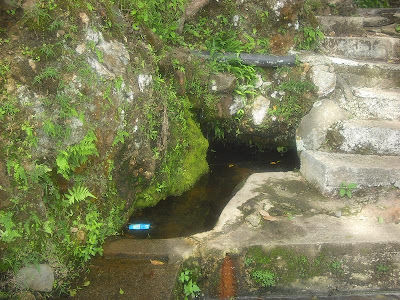
At last, they arrived at a place where water was gushing. From the base of a big tree, water was freely flowing. This could be the only possible place where the pig could stop if it was trying to find something for survival. The pig is wise because it looked for the right place to go and give birth.


 |
| Water from the roots of the Balite tree is still gushing up to now in DANUM. |
 |
| The base of the Balite tree where the water is coming out. |


The men found the pig huddled with its piglets. It was the perfect place to build a village in that there was good supply of water. The family of Kaldoongan soon settled in the same spot where the lost pig led them. And so goes the story of Tadian.
The place was named “Danum” meaning water. Up to now, even during summer, Danum has water where people fetch water when water is scarce.
What is interesting is that, the settlers of Tadian, Mt. Province started with the search of a lost pig. It was the pig that led the family of Kaldoongan to the perfect place to build a home and settle down.
What is interesting is that, the settlers of Tadian, Mt. Province started with the search of a lost pig. It was the pig that led the family of Kaldoongan to the perfect place to build a home and settle down.
How Tadian Came to be
Please give due credit to the author. Do not copy-paste.
by: Felisa Daskeo
The first settlers of Tadian, Mt. Province came from a place called Dallikan, a place in Cervantes, Ilocos Sur, a province in the northern part of the Philippines.
by: Felisa Daskeo
The first settlers of Tadian, Mt. Province came from a place called Dallikan, a place in Cervantes, Ilocos Sur, a province in the northern part of the Philippines.
The story goes that Pagawad, Dallikan’s powerful leader, became abusive as a leader which led to his death. The incident happened when a tribal war ensued and his own people abandoned him to be killed by their tribal enemies.
Pagawad’s death led most of the settlers to abandon the place, leaving behind only a few families. The story goes on with a legendary story of people who followed the roots of a tree called “Batikang”, believed to have uprooted itself from Dallikan to protest the inhuman leadership of Pagawad. People scattered in many places and settled in different places where they built villages of their own. These places were soon named as; Aganayang, Layogan. Alliboo and Baliw-ang. The people soon moved and settled in different places now named as Sumadel, Lubon, Kayan and others.
Those with more food provisions were able to go further; this included the family of Kaldoongan ; believed to be the first family to settle in Tadian.
The story goes that Kaldoongan and a neighbor set out one day to fetch a pig in Baliw-ang. This could only be accomplished in those early days by trekking mountains for days. After two days of trekking slowly with the pig in tow, aggravated by the pig's condition being pregnant and about to give birth; they decided to stop in Paliwak where they tied the pig to rest while they headed home to Tabiyo to get some food provisions.
The next day when they returned to the place, the pig was nowhere to be seen but it left some traces that gave them a lead to follow. They soon arrived in a spot where they found some freshly cut grasses scattered around with footprints that concluded that the pig has rested there for a night; although they spotted no pig around and they had to go on with the search. The place was soon named “Igan” from the Igorot word “nao-igan” meaning cut grasses scattered around.
Kaldoongan and his company continued the search for the pig and soon reached a place where they found some freshly cut grasses gathered and piled together that indicated the presence of the pig in that spot. The place was soon named “Logpop”. From the Igorot word “natotopopan”, meaning grasses gathered together. The men were dismayed because the pig was nowhere to be seen.
It was getting late in the afternoon and without food provision; the men decided to stop the search and go home then return the next day with additional men to continue the search. In those early days, animals were very important to the native settlers, so it was not a surprise if they kept going back in search of just one pig. What worried them more was that the pig could have given birth by now.
The men returned the next day in search of the lost pig and found a spot where they believed the pig settled in for the night because of a mound of freshly cut grasses and some footprints around it. Because of the mound of grasses which they termed, “Napapatog-o”, meaning a mound, the place was soon named Patog-o.
The search was getting better. The men knew that the pig was somewhere around and not too far from them. They however found no pig nearby so the search went on as they followed the lead provided by the pig.
At last, they arrived at a place where water was gushing. From the base of a big tree, water was freely flowing. This could be the only possible place where the pig could stop if it was trying to find something for survival. The pig is wise because it looked for the right place to go and give birth.
|
| Water from the roots of the Balite tree is still gushing up to now in DANUM. |
|
| The base of the Balite tree where the water is coming out. |
The men found the pig huddled with its piglets. It was the perfect place to build a village in that there was good supply of water. The family of Kaldoongan soon settled in the same spot where the lost pig led them. And so goes the story of Tadian.
The place was named “Danum” meaning water. Up to now, even during summer, Danum has water where people fetch water when water is scarce.
What is interesting is that, the settlers of Tadian, Mt. Province started with the search of a lost pig. It was the pig that led the family of Kaldoongan to the perfect place to build a home and settle down.
What is interesting is that, the settlers of Tadian, Mt. Province started with the search of a lost pig. It was the pig that led the family of Kaldoongan to the perfect place to build a home and settle down.
Friday, October 6, 2017
The Igorots and the Untold Stories
Please give due credit to the author. Do not copy-paste.

By: Felisa Daskeo
Most Filipinos probably do not know that a huge number of Igorots are scattered around the world. There’s a top notch lawyer out there, an engineer, an accountant, a business man, a doctor, a police general, but they don’t carry with them tags or banners to identify themselves as Igorots.
Most Filipinos probably do not know that a huge number of Igorots are scattered around the world. There’s a top notch lawyer out there, an engineer, an accountant, a business man, a doctor, a police general, but they don’t carry with them tags or banners to identify themselves as Igorots.
That said, I will now begin to bring you around my humble hometown nestled between tall mountains; where lawyers, engineers, accountants, high ranking policemen, doctors, teachers, nurses, midwives, abound nowadays.
Tadian, Mt. Province is a home to more or less 5000 residents. Of course, they are Igorots, except for a very few that you could count with your fingers who are from other regions in the Philippines, mostly because they have married an Igorot.
In the year 1960s, I could still vividly remember how our elderly would exclaim happily every time an airplane was heard overhead, “Oh, that’s ___________ flying by.” I can’t remember the name of the pilot. I was still a very young girl then. Oh, thanks goodness, someone, a kind kailyan (town mate), shared the name of our first pilot in Tadian. He was the late Victor C. Astudillo.
Now that it is 2017 and I still hear and read expletives hurled against the Igorots, aggravated with descriptions like pigs, pangit, dogyut(untidy), and ignoramus, my thoughts travel back in the 1960s when we already have a pilot in our hometown.
Let's take a break first so I can share this FB post I recently read in Facebook.

Let's take a break first so I can share this FB post I recently read in Facebook.

Yeah, that maybe taken just as a joke but there is truth in those questions. Perhaps you don’t believe it but the man you see resembling a beggar maybe the owner of a multi-million-peso vegetable garden, who supplies the vegetables you eat; who drives a Montero around, who lives in a mansion but who wears no ties, no well-pressed slacks and polo shirt except for worn-out jeans, cowboy boots and a leather jacket.
If you have still time to read, click and read this anecdote of an Igorot man and see what I mean.
Back to where I started, some people think that Igorots are still way behind modern civilization. To tell you the truth, several Igorots are serving many Filipino people. There are judges out there, police superintendents, lawyers, accountants, doctors, midwives, engineers and many more who are working their butts off for the people.
In Tadian, Mt. Province, my hometown, every parent is striving hard to send the children to school. Education is necessary and getting a diploma in college is every child’s dream.
The house below that is as big as 4 townhouses combined is where a CPA-Lawyer resides. Not content to be an accountant and a business owner, she juggled her time between her job, taking care of her thriving business and going to her law class during weekends. She successfully passed the recent bar exams and she’s now a certified lawyer and an accountant. Her accomplishment does not rest in her personal achievements alone because her 3 children are themselves achievers in their schools. They are the top students in their classrooms.

Walk a little further and you can find a humble dwelling that produced 7 smart children who are also achievers in their own field of education. The family has two judges, a nurse, a teacher, a police superintendent, a forester, and a businessman. They have gone a long way in their professions and are all on top of their careers. Two years ago, one of the members of the family was one of the top five among the graduates of PNPA (Philippine National Police Academy). There are more achievers in the family as the family grows.
These are only a few of the achievers in my hometown. This post could become a book if I mention everybody here and tell his or her story one by one. In the neighboring towns, there are countless achievers too. They are either working in the country or else deployed in other countries.
Igorots are hard-working people and dedicated to their jobs. That’s one thing that an Igorot man or woman possesses and there is no doubt about that. What makes them shine even more is that they are frugal and know the importance of money.
It is worth noting that Igorots come in many colors and shapes just like other Filipinos. You can see them anywhere, from the farm to the corporate world, politics, showbiz, furthermore, they can be anywhere, from the freezing cold Canada to the blazing hot desert in the Middle East and they are all working hard just like many other Filipinos.
The Igorots and the Untold Stories
Please give due credit to the author. Do not copy-paste.
By: Felisa Daskeo
Most Filipinos probably do not know that a huge number of Igorots are scattered around the world. There’s a top notch lawyer out there, an engineer, an accountant, a business man, a doctor, a police general, but they don’t carry with them tags or banners to identify themselves as Igorots.
Most Filipinos probably do not know that a huge number of Igorots are scattered around the world. There’s a top notch lawyer out there, an engineer, an accountant, a business man, a doctor, a police general, but they don’t carry with them tags or banners to identify themselves as Igorots.
That said, I will now begin to bring you around my humble hometown nestled between tall mountains; where lawyers, engineers, accountants, high ranking policemen, doctors, teachers, nurses, midwives, abound nowadays.
Tadian, Mt. Province is a home to more or less 5000 residents. Of course, they are Igorots, except for a very few that you could count with your fingers who are from other regions in the Philippines, mostly because they have married an Igorot.
In the year 1960s, I could still vividly remember how our elderly would exclaim happily every time an airplane was heard overhead, “Oh, that’s Victor flying by.” Because at that time, there was already a pilot from Tadian, Mt. Province. I can’t remember the name of the pilot. I was still a very young girl then. Oh, thanks goodness, someone, a kind kailyan (town mate), shared the name of our first pilot in Tadian. He was the late Victor C. Astudillo.
Now that it is 2022 and I still hear and read expletives hurled against the Igorots, aggravated with descriptions like pigs, pangit, dogyut(untidy), and ignoramus, my thoughts travel back in the 1960s when we already have a pilot in our hometown.
Let's take a break first so I can share this FB post I recently read in Facebook.
Let's take a break first so I can share this FB post I recently read in Facebook.
Yeah, that maybe taken just as a joke but there is truth in those questions. Perhaps you don’t believe it but the man you see resembling a beggar maybe the owner of a multi-million-peso vegetable garden somewhere in the Cordillera Region; who supplies the vegetables you eat; who drives a Montero around, who lives in a mansion but who wears no ties, no well-pressed slacks and polo shirt except for worn-out jeans, cowboy boots and a leather jacket.
If you have still time to read, click and read this anecdote of an Igorot man and see what I mean.
Back to where I started, some people think that Igorots are still way behind modern civilization. To tell you the truth, several Igorots are serving many Filipino people. There are judges out there, police superintendents-even generals, lawyers, accountants, doctors, midwives, engineers and many more who are working their butts off for the Filipino people.
In Tadian, Mt. Province, my hometown, every parent is striving hard to send the children to school. Education is necessary and getting a diploma in college is every child’s dream.
The house below that is as big as 4 townhouses combined is where a CPA-Lawyer resides. Not content to be an accountant and a business owner, she juggled her time between her job, taking care of her thriving business and going to her law class during weekends. She successfully passed the bar exams and she’s now a certified lawyer and an accountant. Her accomplishment does not rest in her personal achievements alone because her 3 children are themselves achievers in their schools. They are the top students in their classrooms.
Walk a little further and you can find a humble dwelling that produced 7 smart children who are also achievers in their own field of education. The family has two judges, a nurse, a teacher, a police superintendent, a forester, and a businessman. They have gone a long way in their professions and are all on top of their careers. A few years ago, one of the members of the family was one of the top five among the graduates of PNPA (Philippine National Police Academy). There are more achievers in the family as the family grows. The recent bar exam has added another 2 lawyers in the family.
These are only a few of the achievers in my hometown. This post could become a book if I mention everybody here and tell his or her story one by one. In the neighboring towns, there are countless achievers too. They are either working in the country or else deployed in other countries. And these are all Igorots who are often discriminated in their own country.
Igorots are hard-working people and dedicated to their jobs. That’s one thing that an Igorot man or woman possesses and there is no doubt about that. What makes them shine even more is that they are frugal and know the importance of money.
Igorots are one of the people you could trust. Just look at the taxi drivers in Baguio City who are considered the most trusted taxi drivers in the Philippines. If you hire a taxi in Baguio City, there's no need to worry how much you are going to pay because they charge fairly according to the regular rate and they don't ask for more. If you leave some valuables inside the taxi, you can rest assured that your money, cellphone or other valuables will be given back to you
It is worth noting that Igorots come in many colors and shapes just like other Filipinos. You can see them anywhere, from the farm to the corporate world, politics, showbiz, furthermore, they can be anywhere, from the freezing cold Canada to the blazing hot desert in the Middle East and they are all working hard just like many other Filipinos.
Tuesday, March 1, 2016
5 Misconceptions About Igorots and the Truth About Them
by: Felisa Daskeo
Mr. Carrotman’s sudden surge to online stardom has made many Filipinos asking if Jeyrick Sigmaton is really an Igorot.
Igorots are the most talked about indigenous people in the Philippines today because of Mr. Carrotman who is from Barlig, Mt. Province. Many people are asking the true identity of an Igorot.
Mr. Carrotman’s sudden surge to online stardom has made many Filipinos asking if Jeyrick Sigmaton is really an Igorot.
 |
| Credit to Paul Louie Serrano |
Are Igorots really as good looking as Mr. Carrotman?
There’s this one post in FB that said, Jeyrick doesn’t look like an Igorot because he is not dark with curly hair.
There is nothing to be curious about or nothing to wonder about an Igorot because we are actually not far different from other Filipinos. Igorots are the indigenous group of people with traditions, beliefs and practices that are different from other Filipinos but this does not mean that Igorots are people who look different or who act differently from other Filipinos.
The misconceptions about Igorots and the truth about Igorots.

- Igorots have tails. Many people think that igorots have tails. They don’t have tails because they are human beings and not animals that is a fact. But if the tail is referred to the G-string, yes, Igorots wear G-string but only during occasions where it is needed. After the celebrations, they discard the G-string and wear their normal clothes such as jeans, shorts, shirts, or pants. They don’t wear that loincloth everyday.
- Igorotslive in tree houses. Some people believe that Igorots are still living in tree houses just like those built by the first Filipinos up on the trees to protect themselves from their enemies and wild animals. This is not true. Igorots live in sturdy-built houses that could withstand storms and earthquakes.
 |
| One of the several Igorot Villages in the Cordillera. |
- Igorots are short, dark, with curly hair. Definitely not true. I have never seen an Igorot who is like an Aeta. Igorots are mostly fair-skinned with black straight hair just like most Filipinos.
 |
| They are all Igorots. Three of them are teachers, one is an accountant and one is the wife of the Baranggay Captain. |
- Igorots do not know how to cook. If you are talking about gourmet cooking, I would say yes. Igorots cook simple meals without many food enhancers. That was what it used to be, but in this technologically rich society, many Igorots have learned to cook too just like other Filipinos. In fact, their popular “pinikpikan” has evolved too.
 |
| Traditional cooking of glutinous rice to be wrapped in banana leaves. |
- Igorots are still primitive. Definitely not. In this computer age, Igorots live a lifestyle just like the other Filipinos in the lowlands. They have big, beautiful houses. They have furniture and appliances at home. They have computers and gadgets. They eat adobo, kare-kare, fried chicken, sinigang, sweet and sour, spaghetti, pancit, pizza, hotdog, hamburger, etc.

Igorots may not be the “fashionistas”, they love jeans and shirts, They are not “maarte”, and they prefer to look simple and conservative, and not “maluho” they are very frugal and spend their money only in necessities, but they are definitely not primitive people.
5 Misconceptions About Igorots and the Truth About Them
by: Felisa Daskeo
Mr. Carrotman’s sudden surge to online stardom has made many Filipinos asking if Jeyrick Sigmaton is really an Igorot. Now an award winning actor, Jeyrick is still that simple and humble man.
Igorots are the most talked about indigenous people in the Philippines today because of Mr. Carrotman who is from Barlig, Mt. Province. Many people are asking the true identity of an Igorot.
Mr. Carrotman’s sudden surge to online stardom has made many Filipinos asking if Jeyrick Sigmaton is really an Igorot. Now an award winning actor, Jeyrick is still that simple and humble man.
|
| Credit to Paul Louie Serrano |
Are Igorots really as good looking as Mr. Carrotman?
There’s this one post in FB that said, Jeyrick doesn’t look like an Igorot because he is not dark with curly hair.
There is nothing to be curious about or nothing to wonder about an Igorot because we are actually not far different from other Filipinos. Igorots are the indigenous group of people with traditions, beliefs and practices that are different from other Filipinos but this does not mean that Igorots are people who look different or who act differently from other Filipinos.
The misconceptions about Igorots and the truth about Igorots.
- Igorots have tails. Many people think that igorots have tails. They don’t have tails because they are human beings and not animals that is a fact. But if the tail is referred to the G-string, yes, Igorots wear G-string but only during occasions where it is needed. No human being has a tail.
- Igorots live in tree houses. Some people believe that Igorots are still living in tree houses. Hundreds of years ago, when the Philippines was still covered with thick grasses and forests, Igorots may have lived in tree houses and caves, just like other Filipinos. But the modern times tells me that even Igorots in the mountains live is nicely constructed homes that could withstand storms and earthquakes.
|
| One of the several Igorot Villages in the Cordillera. |
- Igorots are short, dark, with curly hair. Definitely not true.. Igorots are mostly fair-skinned with black straight hair just like most Filipinos.
|
| They are all Igorots. Three of them are teachers, one is a CPA-LAWYER and one is the wife of the Baranggay Captain. |
- Igorots do not know how to cook. Again, this maybe true a long time ago but in this computer age where everybody is already exposed to the modern lifestyle, Igorots are also foodies, crowding the market with there own home-made delicacies. In fact, even the "Pinkpikan" has evolved too with the passing of years. But then again, many Igorots are still entrenched in their traditional, simple way of cooking.
|
| Traditional cooking of glutinous rice to be wrapped in banana leaves. Locally called - patopat. |
- Igorots are still primitive. Definitely untrue. Just like anything else around the world, life evolves, changes, and improves. The Igorot lifestyle has also evolved with the changes that took place around the world. In this computer age, Igorots live a lifestyle just like the other Filipinos.
Igorots may not be the “fashionistas”, they love jeans and shirts, They are not “maarte”, and they prefer to look simple and conservative, and not “maluho” they are very frugal and spend their money only in necessities, but they are definitely not primitive people.
Note: Igorots are scattered around the world. Many Igorots are very successful in their careers, but they aren't wearing tags on their backs, so you will never know that they belong to a tribe that is always discriminated. So, the next time you are eating in a fine restaurant and you see a man in cowboy hat and boots, don't be surprised if he could afford to eat there.
Saturday, February 27, 2016
You Don't Look like an Igorot!!!
 |
| This is a pure blooded Igorot's house. She's a CPA-Lawyer. |
The most annoying part is, every time I say, "I am an Igorot"; I hear the words, "But you don't look like an Igorot.
What exactly do they mean by that phrase?
We, Igorots, don't go online injecting obscenities and expletives about Ilocanos, Tagalogs, Warays, etc, because we believe that everyone is entitled to his own way of life no matter what kind of life you have. To shorten it, we are all Filipinos and we are all the same; there is no difference. Physically, Igorots are not far different from other Filipinos. There are several Igorot men and women who are as good looking as some actors and actresses around.
To set it straight, IGOROTS are not short, small, dark and with curly hair people.
 |
| Surprised to see a good-looking Igorot? Don't be. |
Here are 9 things that you should know about Igorots.
· 1. Igorots are perhaps the humblest people to be around.
An Igorot will tell you that he is living in a shanty but you will find out soon that he is living in a beautiful house complete with good furniture and appliances. She will tell you that she has no money but look into her wallet and you can find thick wads of bills. You can meet a dirty-looking man or woman that you can easily describe as a farmer or vendor, only to find out that he can either be a lawyer, a doctor or an engineer and she, an accountant, a manager or business owner helping in the fields or garden. They will not ask to be called sir or ma’am even if they have master’s degrees and doctorate degrees. They want respect, but they don’t ask for more.
 |
| A cute Igorot boy. |
Parents can go without shoes or good clothes in order to send their children to school. You can see a man or a woman that you will easily mistake as a beggar, but mind you, that man may be the father of a lawyer and that woman may be the mother of three big-time businessmen. They can live without good clothes and other accessories, but they cannot live without a good education for the children.
· 2. Igorots are not fashionistas.
An Igorot is definitely not fond of fashion. But of course, the young generation has different tastes nowadays and could be fashionistas too, but definitely, most Igorots do not go with the flow of fashion trends. Being the rugged type of people in the mountains, they prefer jeans and shirts. She can try wearing a dress for a while but she will always go back to her jeans and shirt because that is what she is used to. Men love to wear all types of jackets, except of course the jackets with so many embellishments. They would prefer the simple leather jacket even if it is expensive. Men also love wearing leather boots.
· 3. Igorots love Country Music and Cowboy Stories/Action Movies.
Igorots love the songs of Kenny Rogers, Don Williams, Alan Jackson, Brad Paisley, Scotty McCreery,, etc. I guess it has something to do with the weather and the geographical setting too. Igorots aren't the drama-type people when it comes to movies. They love action that is why they love Western movies.
· 4. Igorots are practical.
 |
| This is just a portion of Tadian, Mt. Province. Tadian is now crowded with big, beautiful houses. |
Igorots are very practical people. They think first of their necessities before the luxuries and what’s beyond necessary. First thing first, a sturdy house, food on the table and education for the kids. Although some can afford to be sometimes luxurious, they shrug off their shoulders if someone will offer them products that are unnecessary for their daily life. If an Igorot buys something, it must be useful and not something to display or use once in a while.
Igorots live simple lives. They only avail things that are important even if they have the means to be extravagant. They have inherited the frugal lives of their ancestors up to this stage. If made to choose between a sports car and a truck, he would readily choose a truck.
· 6. Igorots always think of the future.
Igorots always set aside something for tomorrow. They are not one day millionaires. An Igorot man will work hard and save because he knows that nothing is permanent in this world. He will always think of the future of his family. Before spending, he will ask himself first, "What if?"
Igorots always set aside something for tomorrow. They are not one day millionaires. An Igorot man will work hard and save because he knows that nothing is permanent in this world. He will always think of the future of his family. Before spending, he will ask himself first, "What if?"
· 7. Igorot men value their family so much.
The number one priority of an Igorot man is a stable family. He works very hard to provide the necessities of the family. He is a responsible man, and he makes sure his family is secured.
· 8. Igorot men and women are DIY people.
Igorots are “do it yourself” people. They can easily organize things even if they didn’t learn about it by using simple common sense. Like me, I am not a carpenter, but I usually do simple carpentry work at home. It is part of being an Igorot to do things on your own and not hire other people to do it for you.
· 9. Igorot women are not frigid.
 A few years ago I read an article in a newspaper talking about women in the mountain regions being frigid. The article further said that this is the reason why more and more men are looking for wives in the lowlands. I almost laughed. Igorot women may not be that very sweet and showy, but they are definitely not frigid.
I am a pure-blooded Igorot and I am definitely not short, small, dark and with curly hair. The next time you hear someone say, "Igorotak" and you can't believe it; don't open your mouth to say, "Oh, but you are so beautiful to be an Igorot." Just admire the Igorot beauty that is in front of you' because out there, there are so many beautiful and handsome Igorots circulating around with you that you aren't aware about.
Copyright Felisa Daskeo 2016
Subscribe to:
Posts (Atom)
Saan Daw Nakatira ang Igorot
Are you also wondering where an Igorot lives? I know. I know. Many people still believe that an Igorot is a primitive, ignoramus human bein...

-
Please give proper credit to the author. Do not copy-paste. by: Felisa Daskeo I've been thinking a lot about the Igorots in this time of...
-
 Please give proper credit to the author. Do not copy-paste. by: Felisa Daskeo I've been thinking a lot about the Igorots in this time of...
 -
by: Felisa Daskeo Begnas is pronounced as (buhg - nas) This is an Igorot celebration before harvest time. The old men have the greatest ...